
Choosing page types for a round
Each round in Welphi is made up of pages, and each page type holds its own kind of questions. This article lists all page types and the questions you can have on each one.
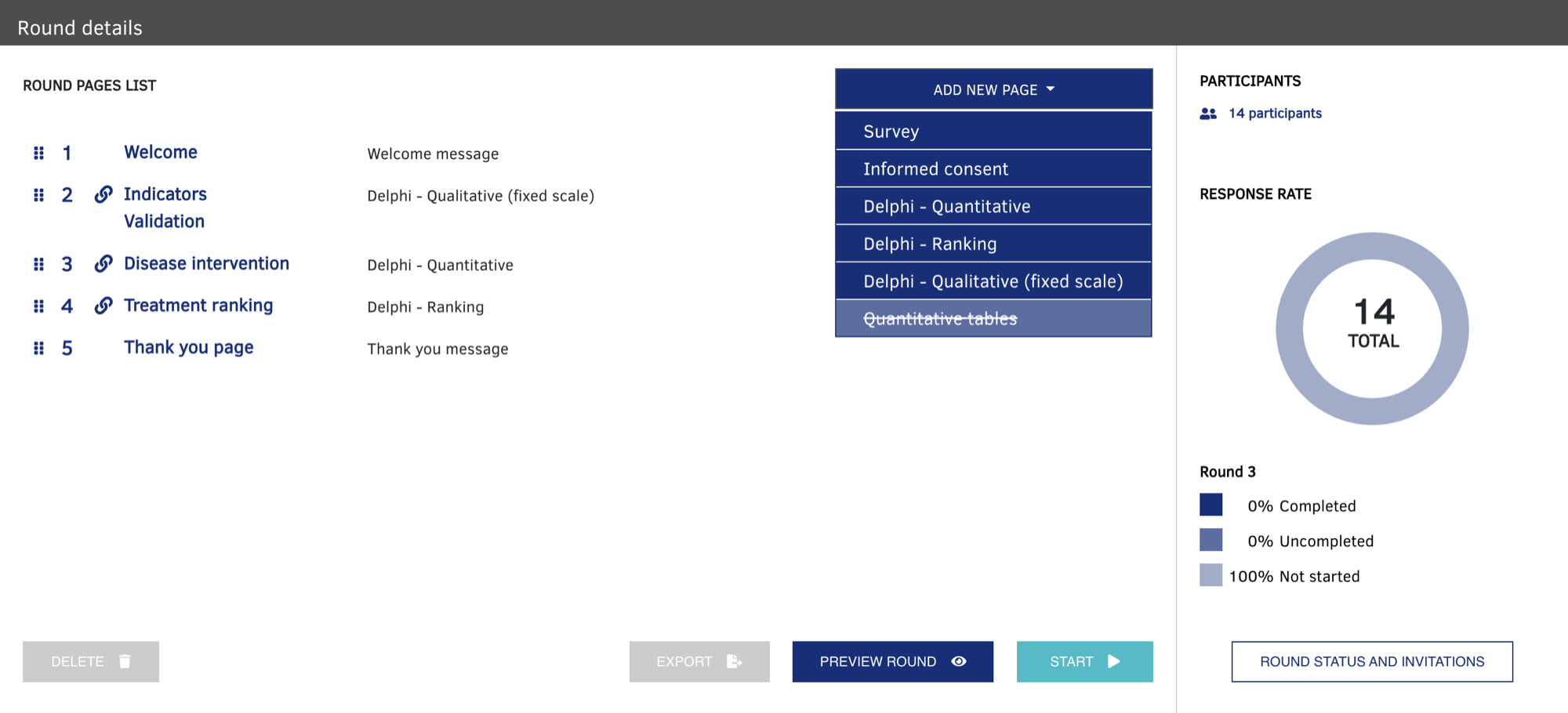
Overview
Delphi processes come in all shapes and sizes. Sometimes you may need to validate a set of options using a qualitative scale, and other times you may need to ask quantitative or even ranking questions.
A few rules apply to all pages:
- Each page type can only hold some types of questions.
- You can include any number of questions on each page, as long as they are of the right type.
- To add a page, click "ADD NEW PAGE" on the "Round details" screen and choose its type.
Welcome pages
In any round you create, Welphi automatically adds a "Welcome message page" as the first page of your questionnaire.
- Purpose – write a message to welcome the participants and explain the study.
- Position – this page must always be the first page of your round.
- Content – fully customisable; it can include text and images.
Thank you pages
Welphi automatically adds a "Thank you message page" as the last page of your questionnaire.
- Purpose – thank the participants for their contributions and tell them about future rounds.
- Position – this page must always be the last page of your round.
Informed consent pages
Plan: available on the Plus and Premium plans. See Which Welphi plan do I need?.
Choose "Informed consent" to add a page with your consent text. Welphi places it right after the welcome page.
- Participants who accept see "Agree" next to their name on the participants status page.
- Participants who do not consent are logged out and cannot continue to the questionnaire.
To keep a record of consent, see Following invitations and participants' progress.
Survey pages
Plan: available on the Plus and Premium plans. See Which Welphi plan do I need?.
Survey pages can be used in many different ways. This is a fully customisable page that you create from scratch, either to present information (introductions, instructions, section explanations, etc.) or to collect information such as demographics.
Page elements
Drag the elements you need from the left panel to the page. You can add as many blocks as you need.
- "FREE TEXT" – titles and texts.
- "OPEN ANSWER QUESTION" – a question with an open answer.
- "CLOSED ANSWER QUESTION" – a question with answer options.
A closed answer question can:
- allow one or several answers ("MULTIPLE CHOICE");
- be shown as radio buttons;
- be required;
- include an answer with a text box (for example "Other, please specify").
Survey answers in later rounds
Unlike Quantitative, Qualitative and Ranking questions, answers to Survey questions are not automatically summarised and shown in the following rounds. However, you can include a survey page with the same questions in several rounds.

Delphi - Qualitative (fixed scale) pages
This page type can be used in many cases that have in common the need for a user-defined qualitative scale. Participants use it to rate a set of elements like indicators, criteria, strategies or policies.
Custom fields and options
- Custom fields – for each element, you can define custom fields to classify or group the elements, or just to give more information about each one. This information is automatically available to all participants.
- Grouping – custom fields also let Welphi group the elements and show them on different pages, or in different sections of the page, with the same scale on all of them.
- Details, comments and order – you can also let participants open the details of each element, add a comment to explain their opinion, and see the elements in random order.


Validating a list of elements
Sometimes the first round of a Delphi study has the single goal of validating a list of elements (criteria, indicators, objectives, policies, etc.) by asking participants to review it. By checking "Participants can add new indicators" (Premium plan) you can do just that.
- Start with an initial list of elements, or leave it empty if you want participants to provide all elements with no starting point.
- If participants think something is missing, they can use a form on the page to add new elements.
- Participants can also propose changes to the elements already on the list, or their removal.
If you then want to collect more information about each element, for example by using a qualitative scale to rate the importance of each element, set up a new round and uncheck "Participants can add new indicators". Welphi automatically copies all the information from this open round to the new round.
You can learn more about setting up a qualitative page in Setting up a qualitative (fixed scale) page.
Delphi - Quantitative pages
Plan: available on the Premium plan. See Which Welphi plan do I need?.
Delphi processes typically include questions where participants answer with a number.
- Setting up – define the units of the answer and the range within which the answer has to fall.
- Answering – participants type into a box or drag an interactive slider.

Second and later rounds
- Chart – data is much easier to understand as a chart, so you can add a chart automatically built with the previous round's answers.
- Forum – a real-time chat where participants can exchange their points of view live. Even if participants have already left the questionnaire, they are warned by e-mail whenever another participant replies to one of their comments.
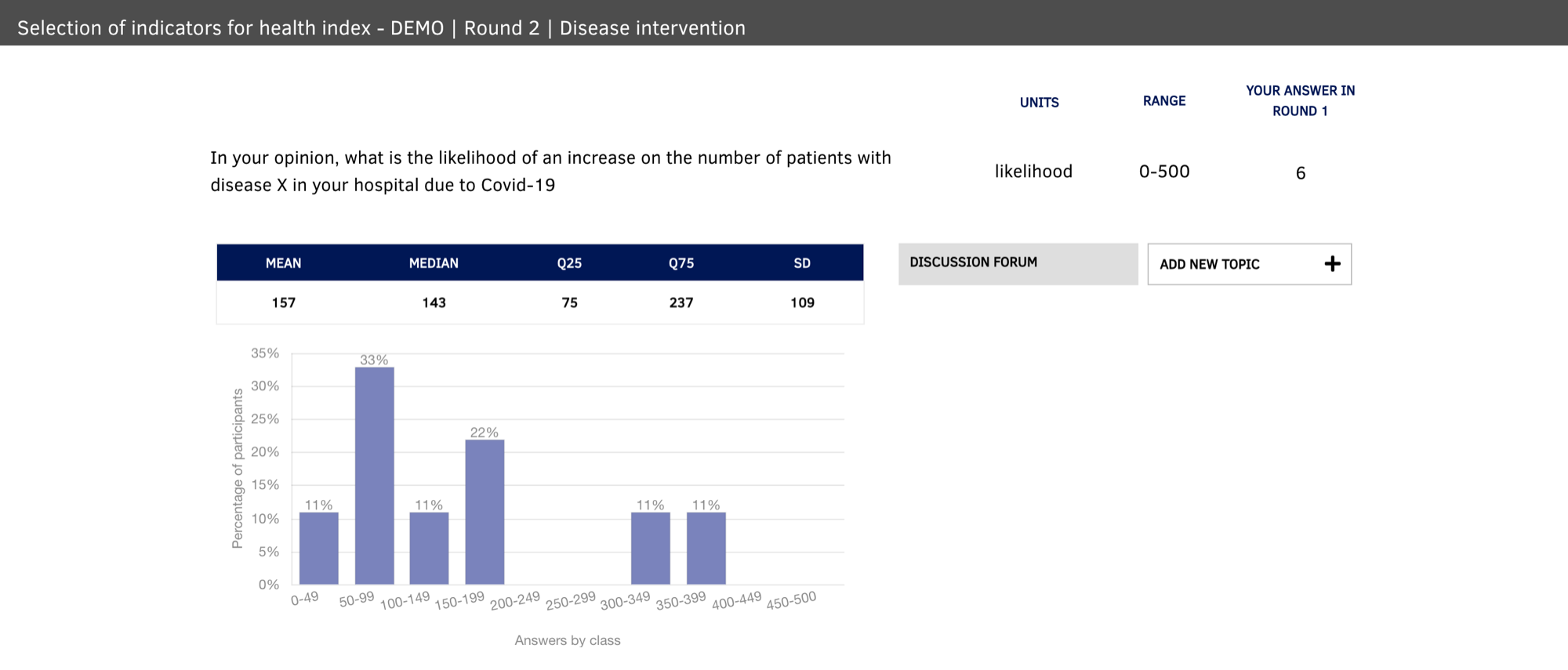

You can learn more about setting up a quantitative page in Setting up quantitative questions.
Delphi - Ranking pages
Plan: available on the Premium plan. See Which Welphi plan do I need?.
A ranking question is a simple type of question where participants are asked to order a set of options according to their preferences, in light of the context presented. These options can be treatments, projects, scenarios, you name it! Participants simply drag and drop the options into their order.

Second and later rounds
Just like quantitative questions, second and later rounds can show:
- a chart automatically built with the previous round's answers;
- a real-time chat (forum) where participants can exchange their points of view live.
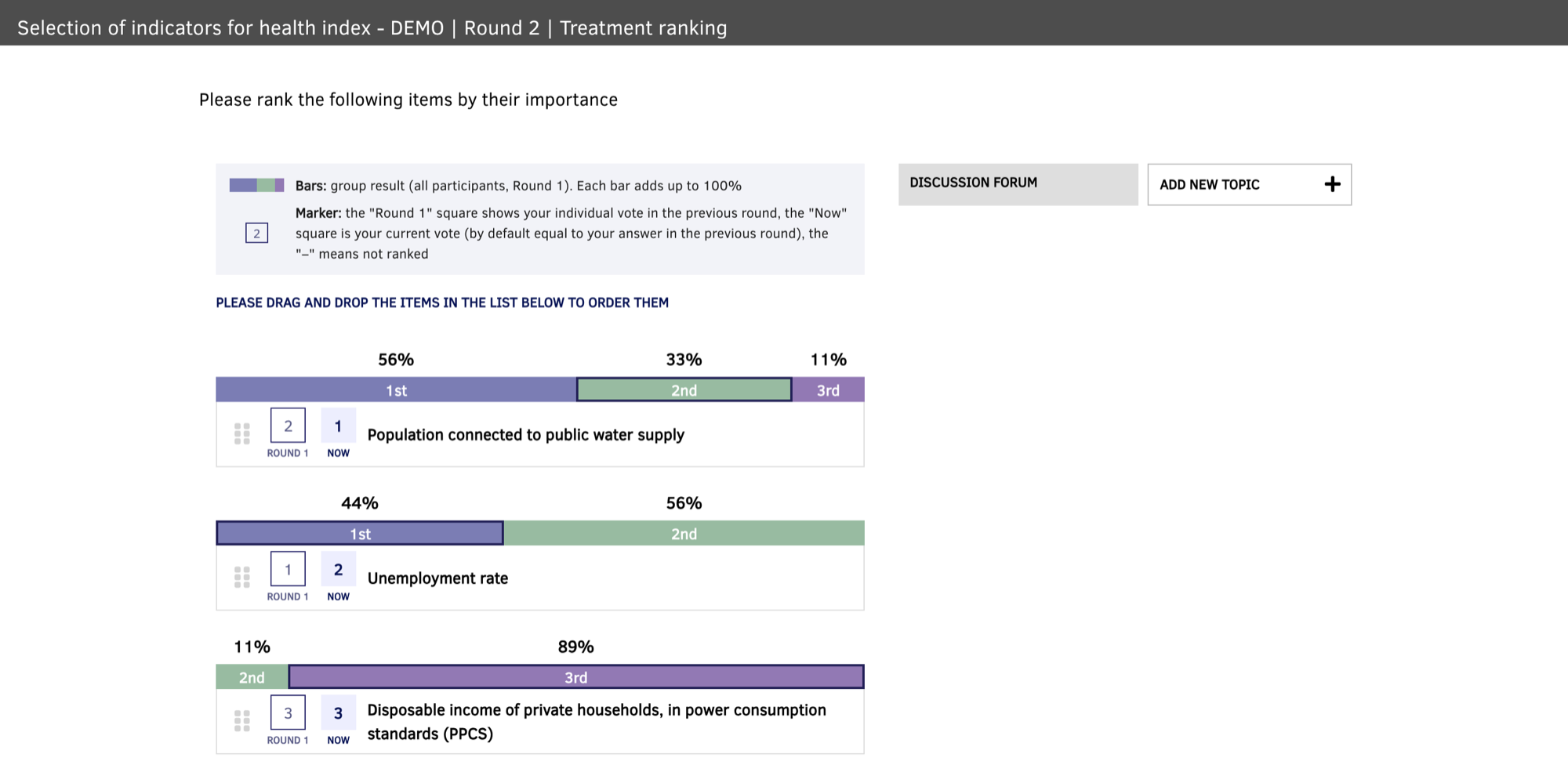
You can learn more about setting up a ranking page in Setting up ranking questions.